AI music does not need another stereo file. It needs a post-stereo format.
Why licensed AI remixes, fan-made covers, and stem-native playback point to the same missing layer
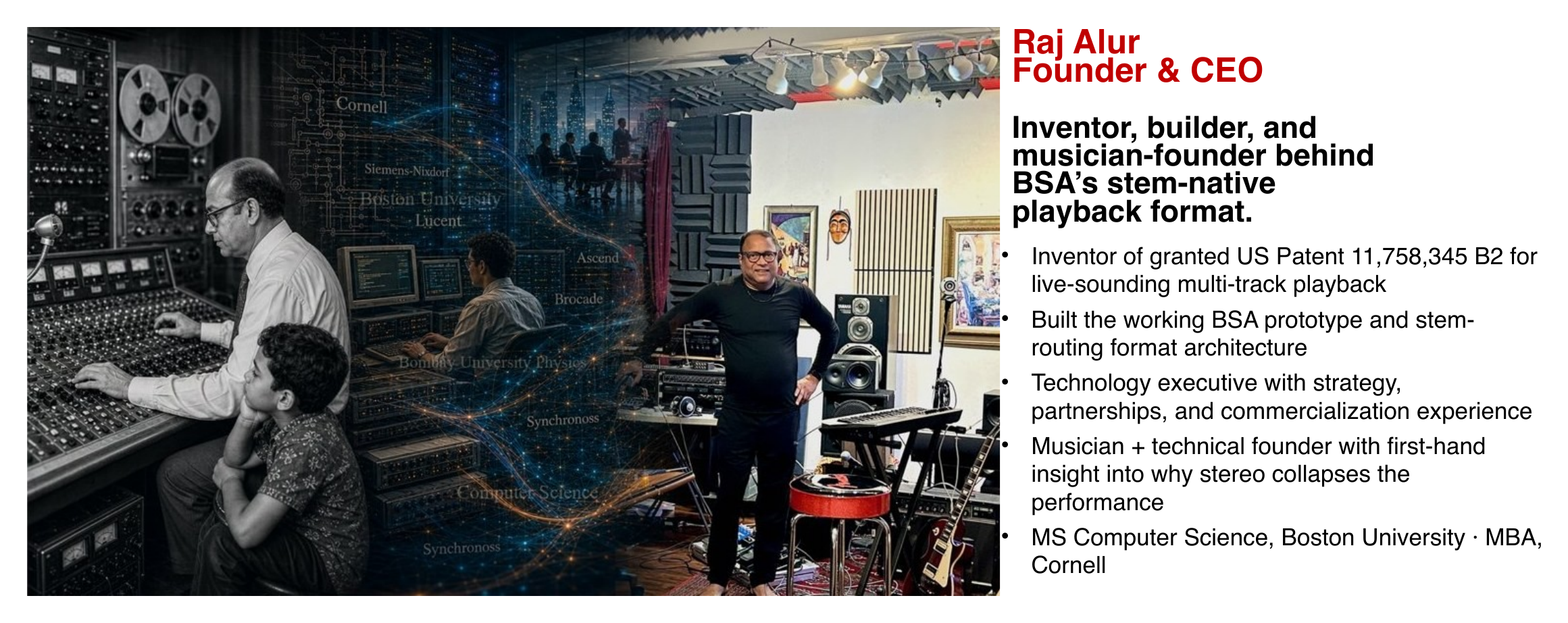
Beyond Stereo Inc. Raj Alur, Founder & CEO May 21, 2026
Executive summary
Spotify and Universal Music Group just announced licensing agreements for a new generative AI tool that will let Spotify Premium users create fan-made covers and remixes from participating artists and songwriters. Spotify described the model around three words the music business has been waiting to hear in the same sentence as AI: consent, credit, and compensation.
That matters. For the first time, one of the largest streaming platforms and the world's largest music company are treating fan manipulation of released music as a licensed product category, not just a legal problem.
But the announcement also exposes a deeper technical gap.
If music is becoming interactive, licensed, remixable, separable, personal, and AI-assisted, why is the final delivery format still a flattened stereo stream?
Stereo was designed for a world where the listener received one finished mix. AI music is moving toward a world where songs can become authorized versions, covers, remixes, instrumentals, vocal-minus mixes, localized arrangements, and adaptive experiences. Those products need rights, metadata, provenance, and payment. They also need a playback format that can carry musical parts as musical parts, not just collapse them back into left and right.
Beyond Stereo Audio, or BSA, is an open stem-native audio format designed for that layer.
BSA stores and plays music as discrete stems with metadata for reconstruction, routing, provenance, and playback translation. It can preserve the original mix, support authorized remix and cover workflows, and route stems across headphones, cars, rooms, venues, and dedicated speaker systems. It is not a generative AI model. It is not a scraping tool. It is a delivery and playback format for authorized stem-based music.
The music industry is beginning to license AI interaction. The next question is how those new musical objects should be packaged, governed, distributed, and heard.
Our answer is simple: the post-stereo era needs a post-stereo format.
1. Spotify's announcement is bigger than AI covers
On May 21, 2026, Spotify and Universal Music Group announced landmark recorded music and publishing licensing agreements. The agreements enable Spotify to launch a generative AI tool for fan-made covers and remixes of songs from participating artists and songwriters. Spotify says the tool will launch as a paid add-on for Premium users and create additional income for artists and songwriters.
The important part is not merely that fans may be able to make AI remixes. The important part is the licensing architecture.
Spotify and UMG are trying to move AI music from the gray market into a controlled, platform-native product:
- participating artists and songwriters choose whether to take part
- rightsholders are licensed before the product launches
- usage can be credited and tracked
- revenue can flow back to the people behind the works
- fans get a legal, mainstream way to engage with music more actively
This is a major change in posture. For the last several years, AI music has largely been framed as a threat: voice cloning, fake artists, spam catalogs, unauthorized training, and impersonation. Those risks are real. But the Spotify/UMG deal signals that the largest players are no longer asking whether fans will manipulate music with AI. They are asking who will control it, who will get paid, and what products can be built responsibly.
That is the opening.
Once fan-made versions are licensed, the platform has to manage more than a finished master. It has to manage identity, participation rights, attribution, versions, stems, model provenance, artist intent, and new playback experiences.
A stereo file can carry the final sound. It cannot carry the full structure of this new economy.
2. The old delivery model flattens the new creative model
For most listeners, recorded music has meant stereo for almost seventy years. Vinyl, cassette, CD, MP3, AAC, FLAC, and streaming all preserve the same basic idea: a final mix is delivered to two channels.
That model worked because the product was fixed. The artist, producer, and mix engineer made the decisions. The listener pressed play.
AI music breaks that assumption. So does stem separation. So does spatial audio. So does automotive audio. So does karaoke, creator tooling, remix culture, and adaptive music in games.
The creation side of music is splitting into parts:
- vocals can be separated
- drums and bass can be isolated
- stems can be licensed
- voices can be modeled or protected
- fan versions can be generated
- mixes can be personalized
- songs can be experienced differently in headphones, cars, venues, and rooms
Yet after all of that, the industry still tends to bounce everything back to stereo for delivery.
That is wasteful. It strips away the structure that made the new experience valuable in the first place.
A fan-made remix is not just a song. It is a relationship between the original work, the participating artists, the generated changes, the stems used, the rights granted, and the playback context. A vocal-minus car demo is not just an alternate MP3. It is a controlled transformation of a song where one musical component can be routed, attenuated, removed, or featured. A spatial version is not just a louder file with more channels. It is a set of musical decisions that should travel with the content.
The industry is licensing interaction. Now it needs delivery semantics for interaction.
3. Spatial audio helped, but it did not solve the stem problem
Dolby Atmos, Apple Spatial Audio, Sony 360 Reality Audio, MPEG-H, and related object-based systems have pushed listening beyond conventional stereo. That work matters. It trained consumers to expect more immersive music. It gave labels and platforms a premium story. It gave cars, headphones, and home systems something better to sell.
But object-based spatial audio and stem-native audio are not the same thing.
Object audio describes how sounds or groups of sounds are placed in a space. BSA starts from a different unit: the musical stem.
A stem has musical identity. It can be a vocal, bass, kick drum, snare, guitar, string section, synth lead, backing vocal group, or residual component. Because the unit is musical, the player can do things a conventional stereo file cannot do cleanly:
- reconstruct the original mix
- solo or mute an instrument group
- preserve original stem volumes
- route bass material to suitable drivers
- place vocals in a stable image
- create a vocal-minus or karaoke experience
- adapt the mix to a car cabin, speaker array, headphone renderer, or dedicated stem speaker setup
- attach provenance and rights metadata to each part
BSA is not positioned as a Dolby replacement. Dolby and similar systems validate the market for premium immersive listening. BSA is the stem-native content and playback layer that can complement many renderers and environments.
If Atmos taught the market that music can have space, BSA gives music addressable parts.
4. What BSA is
Beyond Stereo Audio is a container format and metadata specification for storing, distributing, and reproducing music as discrete stems with playback instructions.
A BSA file can include:
- two to sixty-four audio stems
- instrument classification metadata
- gain, pan, routing, and spatial metadata
- reconstruction data to preserve the original mix
- residual information when needed
- source and provenance data
- rights and participation metadata for authorized workflows
- playback instructions for different environments
The core idea is endpoint reconstruction. The mix is not treated as a dead artifact. The player reads the musical parts and their metadata, then reconstructs the listening experience on the playback device.
That playback device might be a phone, browser, car, speaker array, venue rig, studio tool, or dedicated Beyond Stereo hardware system. The format can support simple stereo fallback, but it does not have to reduce the entire work to stereo internally.
This matters because AI music and remix products are going to create a flood of structured musical assets. Some will come from artists and labels. Some will come from licensed AI tools. Some will come from source separation. Some will come from DAW exports. Some will come from fan interactions.
All of them need a way to remain structured after creation.
BSA is designed to be that way.
5. Why licensed AI needs stem-native infrastructure
The Spotify/UMG announcement is about a tool. The larger opportunity is infrastructure.
Licensed AI music products will need at least five layers to work at scale.
First, they need rights. Artists, songwriters, publishers, labels, and distributors need to decide what is allowed.
Second, they need provenance. Platforms need to know which work, artist, model, voice, stem, or transformation produced a version.
Third, they need accounting. If a fan-made version creates value, revenue has to be allocated.
Fourth, they need quality control. Artist-approved experiences cannot sound like throwaway AI spam.
Fifth, they need playback. The listener has to hear the result in a way that makes the product worth paying for.
Most of the public conversation focuses on the first three. That is understandable because rights and money decide whether products launch. But playback will decide whether listeners care.
If every AI remix becomes just another stereo file in an endless feed, the feature risks becoming a novelty. If the remix remains stem-aware, the experience can become something more durable:
- a premium car mode where the vocal moves cleanly to the center image and rhythm elements occupy physical space
- a karaoke mode that preserves the artist-approved instrumental balance
- a fan remix mode where allowed stems can be swapped, emphasized, or rebalanced without destroying the master
- a creator mode where stems carry licensing and attribution forward
- a listening-room or venue mode where the song becomes physically distributed around the audience
That is the difference between AI as content spam and AI as a new licensed music layer.
6. The 10-second demo problem
Most audio formats fail because the benefit is too abstract.
High-resolution audio can be technically superior and still fail to move mainstream listeners. Quadraphonic sound had real ambition but suffered from incompatible systems, setup friction, and weak catalog momentum. Even successful immersive formats need platform bundling, label participation, playback tooling, and consumer education.
BSA has to pass a simpler test: can someone hear the difference in ten seconds?
The strongest early wedge is not a spec diagram. It is an audible moment.
A listener hears the original stereo mix. Then the same song opens up as stems move into discrete positions. The vocal can be centered or attenuated. The rhythm section can hold the room. Bass can go where bass belongs. The original mix balance can be preserved, but the song is no longer trapped inside two channels.
For automotive, the wedge is even cleaner: karaoke and vocal-minus experiences in a premium cabin. A driver or passenger understands it immediately. No lecture about containers. No standards-body explanation. Just a song they know, made physically interactive in a space already full of speakers.
That is why BSA is not just a technical format. It is a demo-first format.
7. BSA's rights-safe position
BSA should be understood clearly: it is not a tool for unauthorized generation or catalog scraping.
The format is built for authorized stems and controlled playback. It can support artist-supplied stems, label-approved stems, licensed AI outputs, professional DAW exports, and properly permissioned source-separation workflows. It can also carry provenance metadata so platforms and rightsholders know where the parts came from and what they are allowed to do.
That distinction matters now.
The music industry does not need another company telling artists to surrender control in the name of innovation. It needs infrastructure that lets artists and rightsholders say yes to new experiences without losing the work, the credit, or the money.
BSA's role is to make structured music playable, governable, and portable.
8. Why Beyond Stereo is positioned for this moment
Beyond Stereo Inc. has been building around a simple conviction: the next era of music will not be defined only by better compression or louder masters. It will be defined by playback systems that understand the musical parts of a song.
Beyond Stereo has active provisional filings expanding the architecture around format creation, metadata-driven playback, synchronization, and distributed stem workflows.
The company has working demo concepts, a BSA player direction, and a clear product wedge: take stem-separated or artist-supplied music and make the playback advantage obvious across real hardware.
Internal listening data has shown strong listener preference for the Beyond Stereo experience, with 73% overall preference and 91% preference for dense genres. Those numbers should be expanded with larger formal studies, but the early signal matches the intuition: once listeners hear musical parts separated and placed with intent, stereo can feel cramped.
The timing is unusually good.
AI is making stems more available. Labels are moving toward licensed AI manipulation. Cars are becoming premium immersive audio environments. Spatial audio has educated the market. Creator tools are normalizing separated musical assets.
What is missing is the open playback-native format that connects those trends.
9. A practical roadmap for the post-stereo layer
The industry does not need to jump from today's streaming model to a fully interactive stem economy overnight. The transition can happen in stages.
Stage one: authorized stem packaging Artists, labels, and creators export approved stems into a BSA container with reconstruction and provenance metadata. The first use cases are demos, premium listening, karaoke, creator review, and automotive showcases.
Stage two: playback translation BSA players translate the same stem package across headphones, browsers, cars, rooms, and discrete speaker rigs. The same musical work can preserve identity while adapting to the playback environment.
Stage three: licensed fan interaction AI remix and cover tools output structured versions that retain rights metadata, contributor attribution, and playback instructions. Platforms can control what stems are editable, what transformations are allowed, and how revenue is shared.
Stage four: ecosystem standardization The BSA specification, reference encoder, reference player, and developer tools make it practical for hardware companies, music platforms, labels, creator tools, and automotive audio suppliers to support the format.
Stage five: native releases Artists release music directly in stem-native form, not just as stereo masters. Stereo remains as a fallback, but the primary work can be more expressive, adaptive, and valuable.
This is how the shift should happen: not by breaking the current system, but by adding a structured layer that lets the current system evolve.
10. The claim
The Spotify/UMG deal is a signal. The industry is starting to accept that fans will not only listen to music; they will interact with it.
But interaction cannot stop at generation. If AI creates a cover, remix, instrumental, alternate vocal, or personalized version, the result should not be flattened immediately into the same stereo delivery model the industry has used since the 1950s.
That would be like inventing the web and printing every page as a fax.
The new music economy needs formats that understand parts, permissions, provenance, and playback. It needs a way for authorized stems to move through the system without losing meaning. It needs experiences that sound better in ten seconds, not just white papers that read well in boardrooms.
BSA is built for that job.
The future of music will be licensed, stem-aware, interactive, and environment-adaptive.
Stereo will still matter. But it should no longer be the ceiling.
Sources and reference points
- Spotify Newsroom, May 21, 2026: "Spotify and Universal Music Group Announce Landmark Licensing Agreements for Fan-Made Covers and Remixes." https://newsroom.spotify.com/2026-05-21/universal-music-group-spotify-licensing-agreements-fan-made-covers-remixes/
- Spotify Newsroom, Oct. 16, 2025: "Sony Music Group, Universal Music Group, Warner Music Group, Merlin, and Believe to Partner With Spotify to Develop Artist-First AI Music Products." https://newsroom.spotify.com/2025-10-16/artist-first-ai-music-spotify-collaboration/
- Beyond Stereo internal demo and listener preference materials.
About Beyond Stereo
Beyond Stereo Inc. is developing Beyond Stereo Audio, an open stem-native audio format and playback architecture for the post-stereo era. BSA is designed to store, distribute, reconstruct, and route music as authorized stems with metadata for playback translation across headphones, cars, rooms, venues, and dedicated speaker systems.
Contact: Raj Alur, Founder & CEO Website: https://beyondstereo.net